
WI School Nurses
Healthcare Transition is the change from pediatric to adult healthcare services. This transition typically takes place between the ages of 12 and 26 years. This webpage offers tools, resources, and trainings to help Wisconsin School Nurses provide best practice transition care to their patients with developmental disabilities or special healthcare needs.
We are excited to offer some videos to provide insight and inspiration to our awesome Wisconsin school nurses as they help transition our students with disabilities and special health care needs into a self-determined adult life.
Resources for WI School Nurses
-
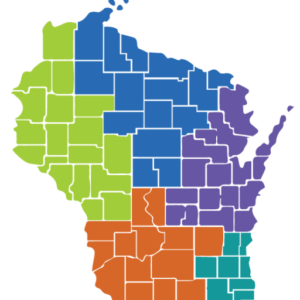
Wisconsin School Nurse Updates Compiled (HCT Articles)
Wisconsin Youth Health Transition Initiative (YHTI) has partnered with Wisconsin DPI School Nursing and Health Services to provide regular articles on Health Care Transition focused on supporting School Nurses. Articles have been…
-
School Nursing and HCT Resources from Minnesota
Partners in Minnesota shared some resources they have developed/presented on: Role the School Nurse in Special Education: Intro to Role of SN SpEd Process 2023 Third Party Reimbursement for Nursing Services on…
-
NASN Position Statement: IDEIA and Section 504 Teams—The School Nurse as an Essential Team Member
NASN Position It is the position of the National Association of School Nurses (NASN) that the registered professional school nurse (hereinafter referred to as a school nurse) is an essential member of…
-

Supporting Students with Special Health Care Needs: The School Nurse and the IHP, 504, and IEP
Ready to be a key advocate in shaping IEP, 504, and IHP plans that truly support students’ health and success? This course uses readings, videos, and case scenarios to describe the laws…
-
Team-Based Care Podcast: Health Care Transition
Team-Based Care is a podcast for the interprofessional healthcare team. Produced by the UW–Madison School of Medicine and Public Health – Office of Continuing Professional Development, speakers from different professions explore a topic or theme…
-

What Youth Want Physicians to Know when Treating Them
High school students were asked how they want physicians to talk to them when receiving treatment. The HEADSS framework, a recognized psychosocial interview framework, was used. HEADSS stands for Home, Education, Activities/Alcohol,…
-

To Improve Student Mental Health, Stop Overlooking School Nurses
It’s time to recognize the critical role school medical personnel play in supporting student mental health, a school nurse explains.
-

Transition Practices in Wisconsin Health Care Systems: What Do We Know?
The transition from youth to adult health care is a complex process, and only 25% of all youth and less than 35% of youth with special health care needs in Wisconsin receive…
-
Conversations: School Nurses and Transition Planning (March 2023)
Louise Wilson, Wisconsin Department of Public Instruction School Nurse Consultant, joins Tim Markle to talk about the overall role of school nurses and how they can be a critical part of successfully…
-
School Nurse Documentation in Career and College Ready IEPs
Part one of this brief summarizes where school nurses document how a student’s health impacts their learning and education under IDEA. Part two of this School Nursing and Health Services Consultant for…
-
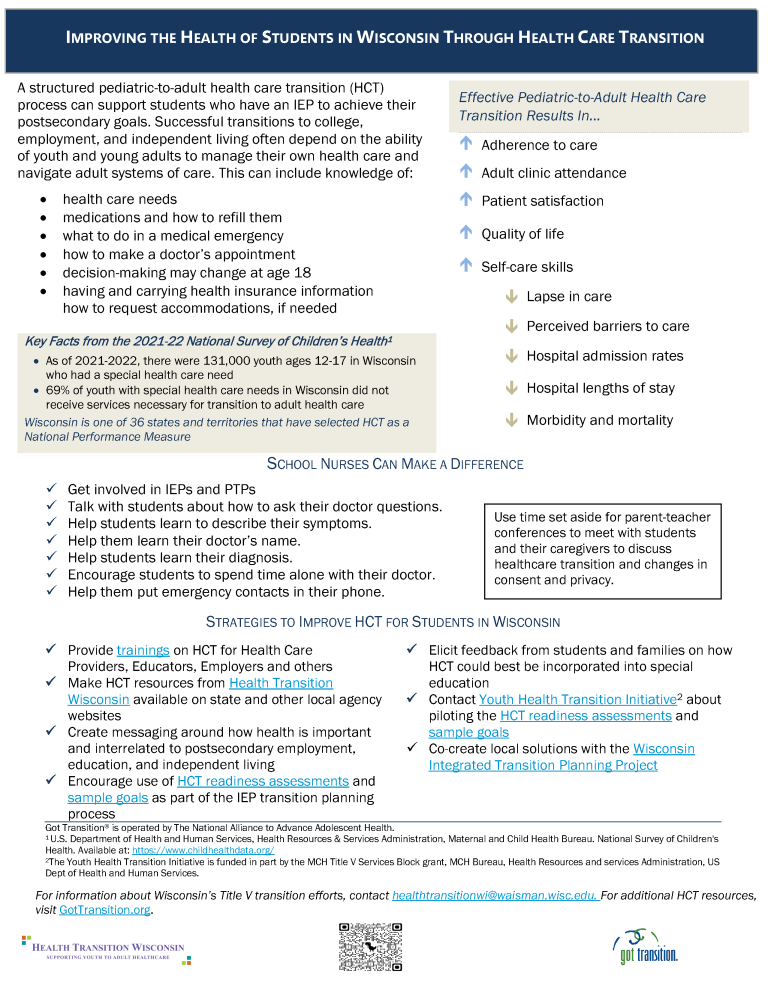
School Nurses Info Sheet on Health Care Transition
A one-page information sheet highlighting current statistics for health care transition, strategies for school nurses to make a difference, and links to resources.
-
Health care transition for children with medical complexity: Challenges and lessons learned
An article from the Journal of Pediatric Nursing published in 2021. Describes the Complex Care Program’s evaluation of its practices prior to 2019 and efforts to standardize transition guidance, planning, and documentation…
-
Promoting Self-advocacy for Young Adults with Chronic and Rare Conditions
An editorial published in the June 2022 issue of the Journal of Pediatric Nursing. Describes Generation Patient, a nonprofit organization created and led entirely by young adult patients. The organization focuses on…